Eden Rock
A nostalgic and poignant exploration of memory, loss, and the afterlife. Charles Causley's 'Eden Rock' is a rewarding poem to study as it offers rich symbolic imagery, an ambiguous narrative, and deep emotional resonance, allowing candidates to explore complex ideas about mortality and parental love.
Study Notes
Overview
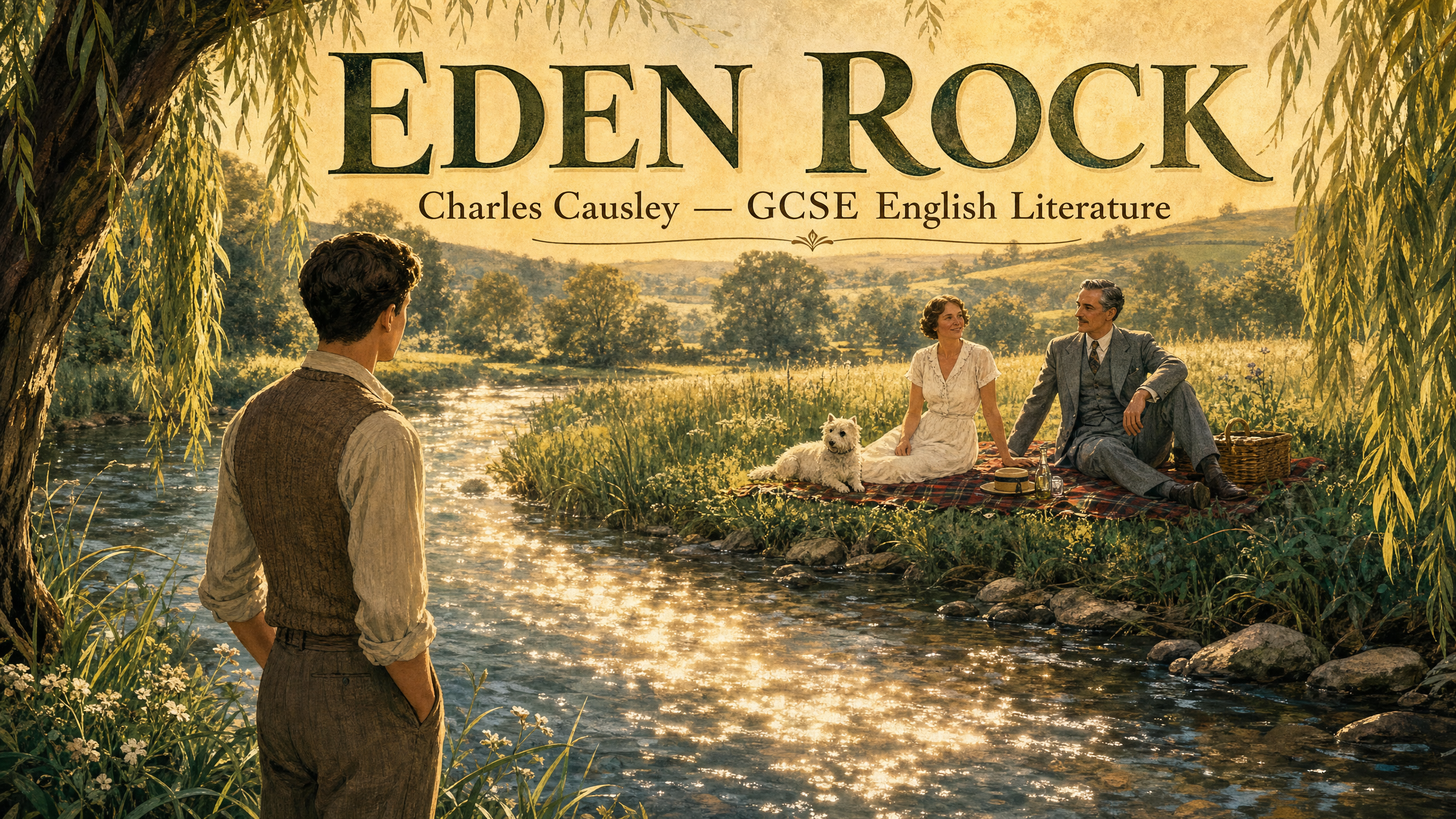
'Eden Rock' is an autobiographical yet deeply symbolic poem by Charles Causley. It presents an idyllic, almost dreamlike vision of the speaker's parents waiting for him by a stream, seemingly in the afterlife. Examiners reward candidates who move beyond reading this as a literal childhood memory and instead explore the poem's metaphysical dimensions. The poem's power lies in its precise sensory details, which contrast with the vast, ambiguous concept of death. Strong responses will integrate analysis of Causley's use of form (free verse, half-rhyme) and structure (tense shifts, the isolated final stanza) to show how he constructs a comforting yet melancholic vision of crossing over.
Audio Revision: The Eden Rock Podcast
Listen to our comprehensive 10-minute audio guide covering core themes, writer's methods, and common exam pitfalls.
Plot/Content Overview
- Stanzas 1-3: The speaker describes his parents sitting by a stream, setting up a picnic. He recalls specific, vivid details about their appearance (his father's suit, his mother's dress and hair) and their actions.
- Stanza 4: The focus shifts to the wider scene. The sky is described as intensely bright, and the parents call out to the speaker, encouraging him to cross the stream.
- Stanza 5: The parents assure the speaker that crossing the stream is not difficult or dangerous.
- Stanza 6: A single, isolated line where the speaker reflects on the experience, creating an ambiguous and emotionally resonant ending.
Themes
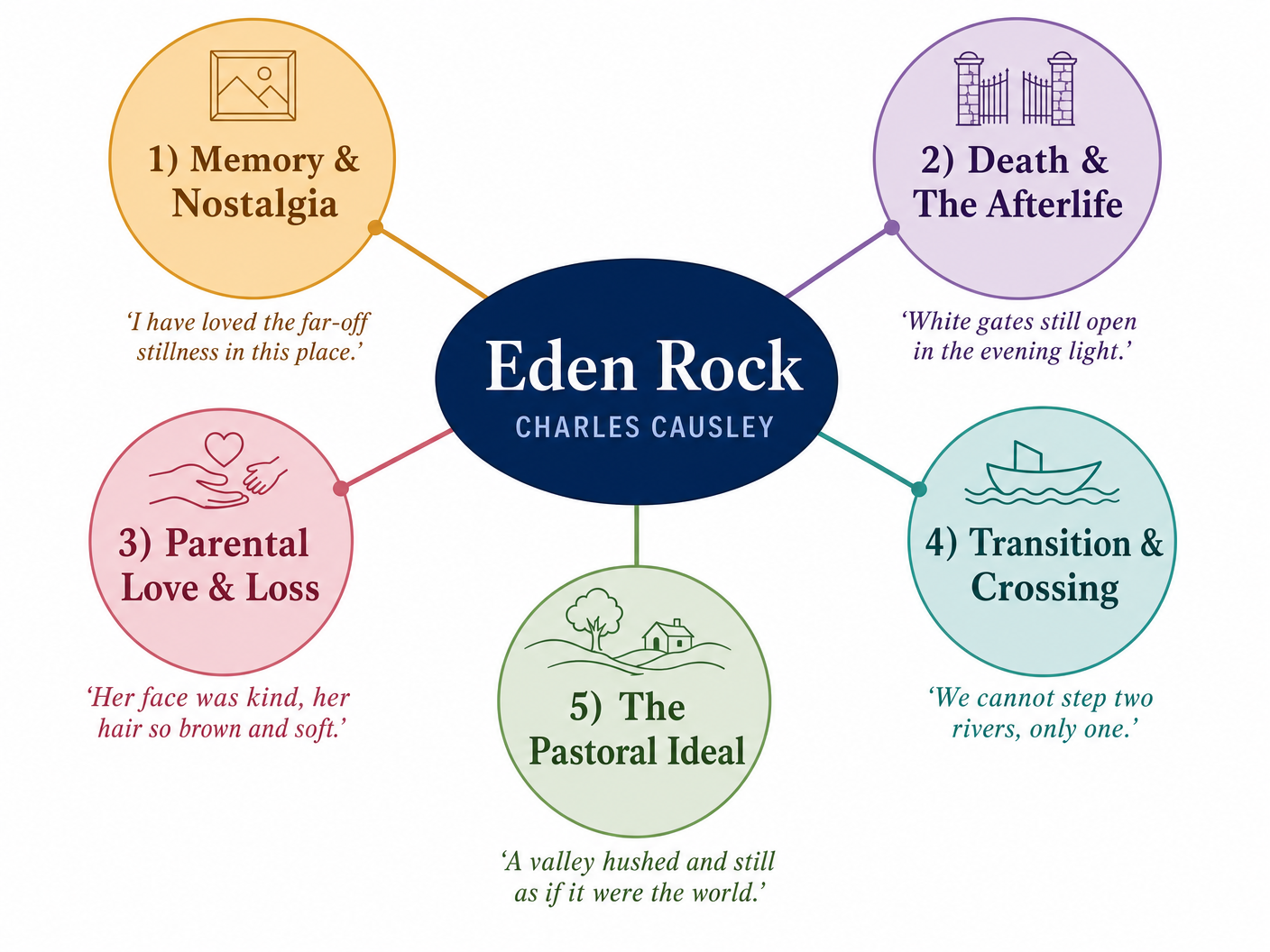
Theme 1: Death and The Afterlife
Causley presents death not as a terrifying void, but as a peaceful reunion. The stream acts as a symbolic boundary (the River Styx in classical mythology) between the living and the dead. The parents are already on the 'other side', waiting patiently.
Key Quotes:
- "They are waiting for me somewhere beyond Eden Rock" - The use of 'Eden' implies a biblical paradise, suggesting the afterlife is a place of perfection and peace.
- "They beckon to me from the other bank" - The parents are actively inviting him over, suggesting death is a welcoming homecoming.
- "The sky whitens as if lit from below" - This ethereal, supernatural light reinforces the otherworldly setting.
Theme 2: Memory and Nostalgia
The poem functions as a vividly detailed memory, yet it is a memory of something that hasn't fully happened yet (the speaker's death). Causley uses hyper-specific details to anchor the surreal concept of the afterlife in comforting, familiar reality.
Key Quotes:
- "Her hair, the colour of wheat, takes on the light" - The sensory precision makes the mother seem incredibly real and present, highlighting the power of memory to keep the dead alive in the mind.
- "He is wearing a suit of genuine Irish Tweed" - The focus on specific materials ('genuine') shows how deeply the speaker cherishes these details.
Theme 3: Parental Love and Tranquillity
The relationship depicted is one of absolute calm and profound connection. There is no anxiety or urgency; the parents simply wait, demonstrating enduring love that transcends death.
Key Quotes:
- "She pours tea from a Thermos, the milk straight / From an old H.P. sauce-bottle" - These mundane, domestic details ground the poem in a sense of ordinary, reassuring family life.
- "Crossing is not as hard as you might think" - The parents offer comfort and reassurance, fulfilling their protective role even in the context of death.
Writer's Methods
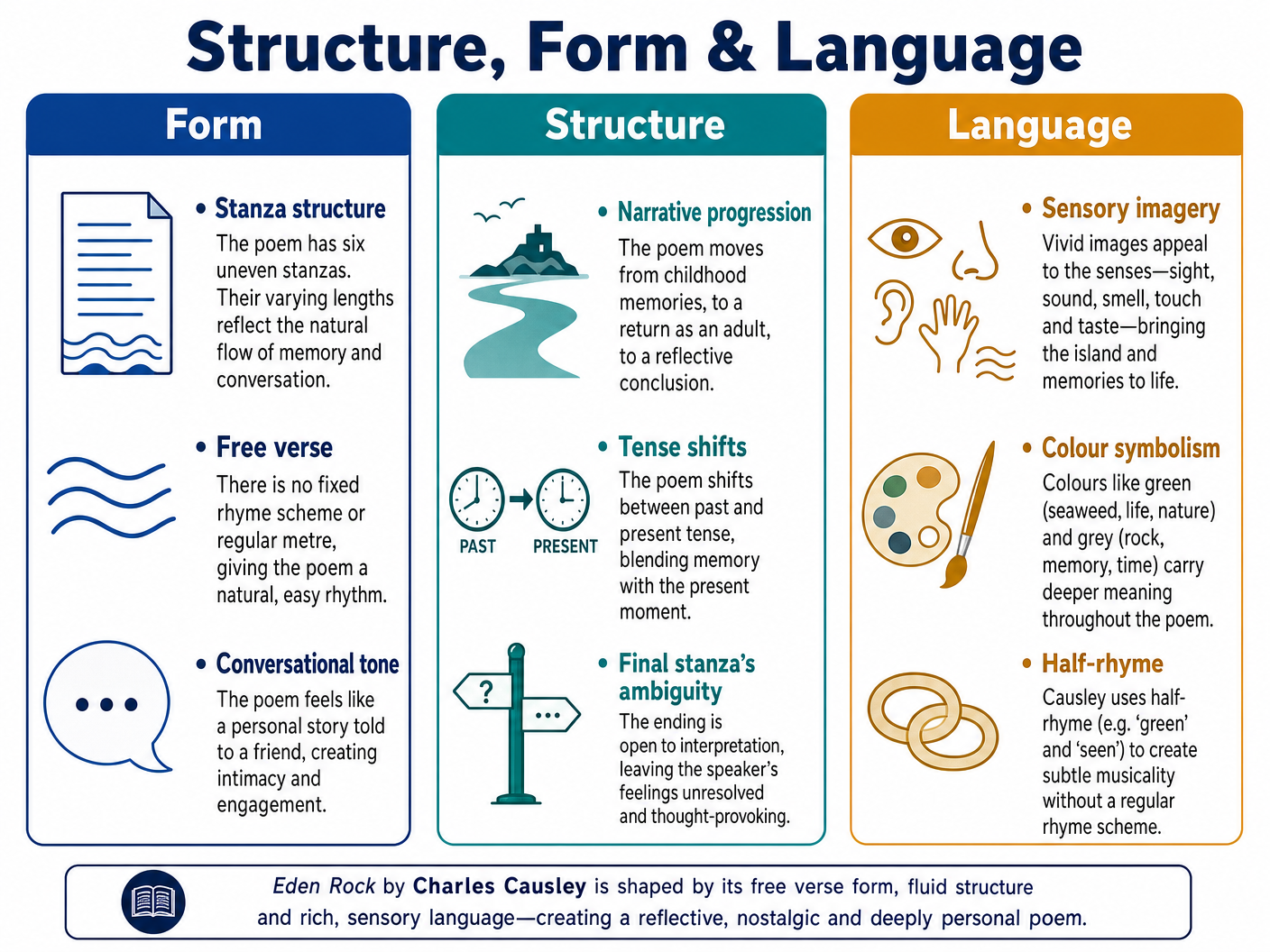
Structure and Form:
- Stanzas: The poem is composed of five quatrains (four-line stanzas) and one isolated final line. The regular quatrains reflect the steady, calm nature of the parents and the peaceful setting. The final, separated line visually represents the speaker's isolation on his side of the stream and the sudden jolt of realisation.
- Rhyme: Causley uses half-rhymes (e.g., 'rock'/'block', 'dress'/'glass'). This creates a sense of harmony but also a feeling of incompleteness or dissonance, mirroring the fact that the family is not yet fully reunited.
- Enjambment: The flowing lines (e.g., "the milk straight / From an old H.P. sauce-bottle") create a gentle, unhurried rhythm, reflecting the peaceful atmosphere and the continuous flow of the stream and time.
Language:
- Sensory Imagery: Vivid visual and tactile descriptions make the imagined scene feel tangible and real.
- Symbolism: The 'stream' is a universal symbol for the boundary between life and death. 'Eden' symbolises an idyllic paradise.
- Tense: The poem uses the present tense ("They are waiting"), making the memory or vision feel immediate and ongoing, suggesting that in the speaker's mind, his parents are eternally present.
Context
Charles Causley (1917-2003) was a Cornish poet. He was an only child; his father died when he was just seven years old, after returning from World War I. He lived with his mother for most of his life until her death. Understanding this biographical context adds profound poignancy to the poem: it is the imagined reunion of a family that was fractured early in the poet's life. However, examiners expect candidates to use context to illuminate the text, not just state biographical facts. The poem also draws on a long literary tradition of the 'pastoral elegy', using an idealized rural landscape to explore grief and mortality.
Worked Examples
2 detailed examples with solutions and examiner commentary
Practice Questions
Test your understanding — click to reveal model answers
Compare how poets present ideas about memory in 'Eden Rock' and in one other poem from your anthology. (30 marks)
Hint: Focus on how memory is presented as comforting in Causley's poem, and contrast this with how it might be painful, burdensome, or fading in your chosen second poem.
Starting with this poem, explore how Causley uses settings to create mood and atmosphere. (24 marks)
Hint: Look closely at the descriptions of light, the stream, and the specific items in the setting. How do they combine the everyday with the supernatural?